
Last Updated on 2 months ago by Admin
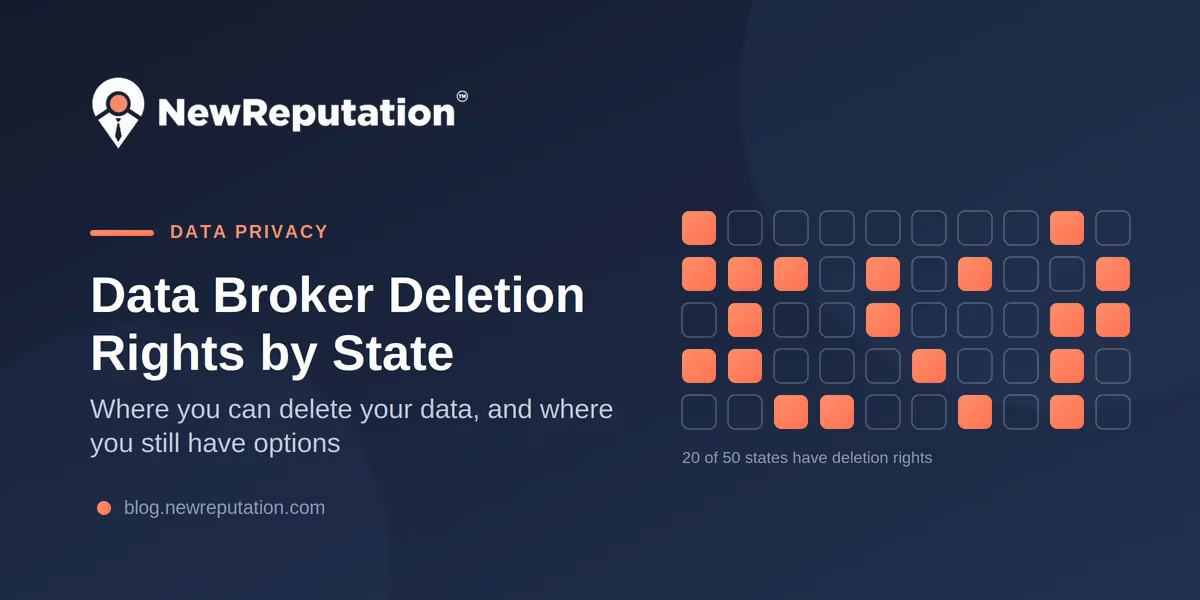
Your right to delete your personal information from data brokers depends almost entirely on which state you live in. There is no federal data deletion law in the United States. Instead, 20 states have passed comprehensive privacy laws that give residents the right to demand deletion, and California goes furthest with a tool that hits every registered broker at once. If you live in one of the other 30 states, you still have real options, they just take more work. This guide maps what you can do, wherever you live.
The short version: check whether your state is on the list below, use the strongest tool available to you, and know that even residents of states with no privacy law can still get most national brokers to delete their data. Here is how it breaks down.
Table of Contents
Why There’s No National Deletion Right
Many people assume there is a single federal law that lets any American delete their data. There is not. Congress has introduced several comprehensive privacy bills over the past decade, and none has become law, largely because of a standoff over whether a federal law should override stronger state laws or simply set a floor.
The result is a patchwork. Your deletion rights come from your state, not from Washington. Twenty states have built comprehensive privacy laws that include a right to delete. The rest have not, which means residents there rely on other tools we cover below. This is why two people with identical data can have very different options depending on their zip code.
Most large national data brokers are based in or do business in California, so they build their systems around California’s law. In practice, many honor California-style deletion requests from residents of any state rather than checking where each request comes from. That does not give you legal enforcement power if you are outside a privacy-law state, but it means a direct request often works anyway.
California: The Strongest Rights in the Country
If you live in California, you have the most powerful data deletion tool available to any American. The California Delete Act created DROP, the Delete Request and Opt-out Platform, a free state-run system where a single request reaches every registered data broker at once, more than 600 of them. Brokers must process these requests, delete matched data, and stop selling it, with penalties of $200 per day per consumer for failing to comply.
No other state has a one-request-hits-all mechanism like this yet. If you are a California resident, DROP should be your first step, and we cover exactly how to use it, including the traps most people miss, in our guide on California’s DROP deadline.
Californians also have the underlying CCPA right to request deletion directly from any individual business, which covers companies that are not registered data brokers.
The 20 States With Deletion Rights
As of 2026, these 20 states have comprehensive privacy laws in effect that give residents the right to request deletion of their personal data. Nearly all follow a similar template: you can request access, deletion, and correction of your data, and opt out of its sale, with businesses generally required to respond within 45 days.
| State | Notable detail |
|---|---|
| California | Strongest in the US. Delete Act plus DROP (one request, all registered brokers). Dedicated regulator, no cure period. |
| Texas | Also requires data broker registration. Aggressive enforcement, no revenue threshold for who must comply. |
| Oregon | Also requires data broker registration. Standard deletion and opt-out rights. |
| Colorado | Established law with universal opt-out (Global Privacy Control) recognition. |
| Connecticut | Strong framework; a one-request deletion mechanism is planned for 2028. |
| Virginia | One of the earliest laws; full access, deletion, and opt-out rights. |
| Utah | Consumer rights framework, with amendments effective mid-2026. |
| Maryland | Among the strongest; bans the sale of sensitive personal information outright. |
| Delaware | Effective 2026; standard deletion, correction, and opt-out rights. |
| Indiana | Effective January 1, 2026. |
| Kentucky | Effective January 1, 2026. |
| Rhode Island | Effective January 1, 2026. |
| New Jersey | Full consumer rights framework including deletion. |
| New Hampshire | Standard deletion and opt-out rights. |
| Minnesota | Includes additional profiling transparency rights. |
| Montana | Standard rights framework. |
| Nebraska | Standard rights framework. |
| Tennessee | Standard rights framework. |
| Iowa | Narrower than most, but includes deletion of data you provided. |
| Washington | Comprehensive framework, with strong separate protections for health data. |
Effective dates, thresholds, and rights are amended every legislative session, and more states are expected to join this list before the end of 2027. Treat this as a current snapshot, not legal advice, and confirm your state’s specifics with your state attorney general’s office before relying on a deadline or a particular right.
See Which Brokers Have Your Data
Deletion rights only help if you know where your information is. NewReputation’s free scan shows which data brokers and people-search sites are exposing your personal details right now.
- Find the sites exposing your address, phone, and relatives
- See what appears when someone searches your name
- Free scan, no obligation
How to Use Your State’s Deletion Right
Outside California’s DROP, deletion in every other state is a broker-by-broker process. You do not get one universal request. You exercise your right with each company individually. Here is the reliable way to do it.
- Find out who has your data. Start by identifying which brokers and people-search sites list you. Searching your own name is a start, but the coverage is much wider than what shows on page one.
- Submit a deletion request to each broker. Look for a “Privacy,” “Do Not Sell or Share My Personal Information,” or “Your Privacy Rights” link, usually in the site footer. Cite your state’s privacy law and request deletion of all your personal data.
- Verify your identity if asked. Brokers can require reasonable verification before deleting. Provide only what is necessary.
- Track the clock. Most state laws require a response within 45 days, sometimes with a permitted extension. Note the date you submitted each request.
- Escalate if they ignore you. If a broker misses the legal deadline, file a complaint with your state attorney general’s consumer protection division. State AGs enforce these laws, and a business that ignores a valid request is exposed.
- Repeat periodically. Brokers re-collect data from public records continuously, so a one-time deletion is rarely permanent. Plan to repeat the process every several months.
Our guides on removing yourself from people-search sites and how long data broker opt-outs take cover the details of the broker-by-broker process and what to realistically expect.
What to Do If Your State Has No Privacy Law
If you live in one of the 30 states without a comprehensive privacy law, you are not out of options. You lack a statutory deletion right you can enforce, but three things still work.
Use the CCPA effect. As covered above, most national brokers honor California-style deletion requests from anyone, because it is easier than sorting requests by state. Submit deletion requests anyway. They frequently succeed. This is the single biggest reason the practical gap is smaller than the legal gap.
Use each broker’s own opt-out. Every major data broker maintains its own opt-out process, independent of state law, partly to comply with California and partly for public relations. These work regardless of where you live. Our guide on removing your personal information from the internet walks through them.
File a deceptive-practices complaint. Every state has a consumer protection statute against unfair or deceptive business practices. If a broker’s own privacy policy promises to honor deletion requests and then ignores yours, that can be a deceptive-practices violation in any state. File a complaint with your state attorney general.
Do not let the absence of a state law stop you. Submit deletion and opt-out requests to the brokers directly. In practice, the large national brokers that hold most of your data will usually process them. The work is the same broker-by-broker effort residents of privacy-law states face outside California.
What’s Coming Next
The map is still being drawn. More states are expected to enact comprehensive privacy laws through 2026 and 2027, and a few have already passed laws that are not yet in effect. Connecticut is building a centralized deletion mechanism, similar in spirit to California’s DROP, expected by 2028. That one-request model is the direction the strongest states are heading.
For now, California remains the only state where a single request clears every registered broker at once. Everywhere else, deletion is a manual, repeatable process, but it is a process that works if you stay with it. And wherever you live, the practical reach of California’s law through the national brokers means you can start today.
Frequently Asked Questions
Is there a federal law to delete my data from data brokers?
No. As of 2026, the United States has no comprehensive federal privacy or data deletion law. Several bills have been introduced over the years, but none has passed, mainly due to disagreement over whether a federal law should override stronger state laws. Your right to demand deletion comes from your state. Twenty states have comprehensive privacy laws that include a deletion right; the other 30 do not, though residents there still have practical options.
Which states let me delete my data from data brokers?
Twenty states have comprehensive privacy laws in effect in 2026 that include a deletion right: California, Colorado, Connecticut, Delaware, Indiana, Iowa, Kentucky, Maryland, Minnesota, Montana, Nebraska, New Hampshire, New Jersey, Oregon, Rhode Island, Tennessee, Texas, Utah, Virginia, and Washington. California is the strongest, with its DROP platform reaching all registered brokers in one request. The others require you to submit requests to each broker individually, usually with a 45-day response deadline.
What if my state doesn’t have a privacy law?
You still have options. Most large national data brokers honor California-style deletion requests from residents of any state, because they build their systems around California’s law rather than checking each requester’s location. You can also use each broker’s own opt-out process, which works regardless of your state. And if a broker’s privacy policy promises to honor deletion but ignores your request, that can be a deceptive-practices violation you can report to your state attorney general.
How long does a broker have to delete my data?
In states with comprehensive privacy laws, the standard is usually 45 days from your request, though some laws allow a limited extension. In California, registered brokers must process DROP requests on a recurring cycle, checking the platform at least every 45 days and deleting matched data within 90 days. If a broker misses the legal deadline in your state, you can file a complaint with your state attorney general’s consumer protection division.
Does deleting my data from brokers keep it gone for good?
No. Data brokers continuously re-collect information from public records, court filings, and other sources, so profiles often reappear months after deletion. This is true in every state, including California. Effective removal means repeating the process periodically and monitoring for your information resurfacing. Many people use an ongoing service for this reason, since keeping data deleted is a maintenance task rather than a one-time fix.
Deletion Rights Are Only Half the Battle
Whatever your state allows, keeping your data gone takes ongoing work. NewReputation removes your information across hundreds of brokers and people-search sites, in any state, and keeps monitoring so it stays down.
- Removal across hundreds of sites, in every state
- Broker-by-broker requests handled for you
- Ongoing monitoring so your data does not resurface

West Virginia alumni with a background in marketing and sales for both established companies and startups.