
Finding a post about you or your business on Gripeo can feel jarring. Most people do not even know the site exists until their name suddenly appears there, usually attached to words like “scam” or “fraud.” At that point, the question becomes urgent.
How do you remove a Gripeo post?
The answer is not simple, and anyone who tells you otherwise is not being honest. Gripeo does not operate like a normal review platform, and understanding how it works is the first step toward dealing with it properly.
What Gripeo Is and Why It Causes Problems
Gripeo.com launched in 2014 and was initially marketed as a platform where consumers could file complaints regarding businesses, professionals or individuals who acted unethically. Its original look resembled that of other review platforms.
At some point thereafter, however, the site’s format began to change.
In 2020, Gripeo changed ownership, and since then, many individuals have noted a drastic change in how Gripeo functions. Posts now seem more like accusations than reviews. Headlines tend to be sensationalized. The context behind a post seems to be sparse. Additionally, verification appears to be inconsistent.
While Gripeo spends significant money on search engine optimization, its posts frequently appear on Google ahead of an individual’s official website or reputable news sources.
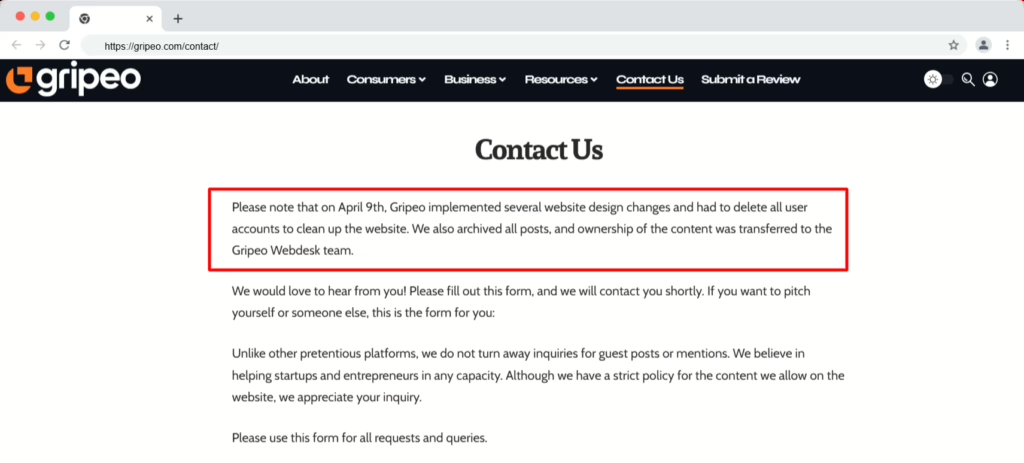
Additionally, in April 2025, Gripeo removed all user account information when they performed a redesign of their website. That made it impossible to determine who authored the posts while the articles were still live on the website.
Therefore, the parties subject to those posts have been left vulnerable, with few avenues of recourse.
Why Gripeo Posts Are So Hard to Remove
Gripeo rarely deletes content voluntarily. Many individuals attempt to contact the site and request the removal of a post; that method is usually unsuccessful.
A large number of documented instances report that Gripeo responds to requests to remove content by offering paid removal services. While some of the prices charged by Gripeo are in the hundreds, others are in the thousands of dollars. When an individual refuses to pay, Gripeo has been known to generate new posts about the same issue, thereby increasing its scope rather than resolving it.
This pattern has led many critics to label the site’s behavior as exploitative.
Although Google has acknowledged similar sites for engaging in “exploitative removal practices,” enforcement varies. Gripeo continues to operate, and posts remain live in most cases.
Why Legal Threats Against Gripeo Usually Fail
Many individuals assume they can issue a threat of a lawsuit to compel the removal of a post. However, as stated previously, that is rarely the case.
Gripeo protects itself under Section 230 of the Communications Decency Act. That statute provides immunity to providers of online services regarding material provided by another party (i.e., users). Therefore, in most cases, courts dismiss lawsuits filed against Gripeo because Gripeo claims to host only the postings generated by users.
Additionally, in some documented instances, Gripeo has ignored court orders requesting the removal of a post. According to Gripeo, it is protected by Section 230 and therefore has no obligation to comply with court orders.
Thus, in most cases, issuing a legal threat against Gripeo results in nothing.
When Legal Action Can Work
Legal action can still matter, but only in a narrow way.
If a post contains defamatory statements, the law allows for a “John Doe” lawsuit. This type of case targets the anonymous poster rather than the platform. Through subpoenas, an attorney may attempt to unmask the person who wrote the post.
If you can identify the author and prove wrongdoing, removal becomes more realistic.
However, this path takes time. It costs money. And it does not guarantee success. For many people, it is not the fastest or most practical solution.
Why Gripeo’s Own Guidelines Rarely Help
On paper, Gripeo lists rules against certain types of content. These include threats, hate speech, doxxing, and harassment.
In theory, violating posts should come down.
In practice, enforcement is inconsistent. Many posts that appear to break these rules remain live after reports. Others disappear without explanation. There is no reliable pattern.
Because of this, relying on internal reporting tools often leads to frustration.
What Actually Works in Most Cases
Based on real-world experience, the majority of successful removals are handled by third-party reputation management companies that understand how Gripeo operates.
Reputation companies employ a combination of negotiation, leveraging of company policies and technical tactics to remove Gripeo posts.
This does not mean every case is winnable; many posts will not be removed. Other posts may require different approaches. However, compared to individual attempts at removal, third-party reputation management companies consistently achieve greater success.
Why Self-Removal Usually Backfires
Generally, attempting to address a Gripeo issue independently will only make matters worse.
Contacting Gripeo directly will often prompt them to demand payment for removal services. Responding publicly to a post may attract additional attention to the post. Issuing legal threats without follow-through may escalate the situation rather than resolve it.
In addition to these consequences, time is working against you. The longer a post remains live, the more times it is indexed by search engines and the more visible it is to the public.
As a result, many individuals end up engaged in damage control instead of finding a viable solution.
De-Indexing as a Partial Option
When removal is not immediately possible, de-indexing can help reduce harm.
Search engines sometimes remove or suppress content that qualifies as outdated, misleading, or exploitative. Google offers tools for this, although approval is not guaranteed.
De-indexing does not delete the Gripeo post itself. It simply makes it harder to find through search. For some people, that relief is enough in the short term.
Still, it is not a full solution.
When Takedowns Become a Business Model
Over the years, investigations and media reports have shown that some reputation and complaint ecosystems did not operate independently at all. Instead, they worked together in ways that blurred the line between reputation management and extortion.
Multiple reports, including a 2021 investigation by The New York Times, described situations where the people running certain complaint or “slander” sites were also connected to companies offering paid removals. In these cases, damaging posts appeared first. Soon after, the subject of the post received outreach offering a way to make the problem disappear, usually for a substantial fee described as an “administrative” or “processing” cost.
One name that has surfaced in public reporting is Heidi Glosser, who has been identified as the owner of 247Removal.com. Ads for that service have appeared on Gripeo and other related sites, raising obvious concerns about conflicts of interest. The appearance alone suggests a closed loop where harm and “solutions” exist side by side.
Investigations have also tied similar patterns to sites such as DirtyScam.com, Gripeo.com, BadGirlReports.date, and others. In those cases, the same operators allegedly benefited twice: first from hosting sensational or unverified accusations, and then from charging people to reduce or remove the damage those accusations caused.
Critics have described this setup as a symbiotic extortion model. The leverage comes from visibility. The revenue comes from fear.
Even more established platforms have faced criticism for similar practices. Ripoff Report, for example, does not remove posts but offers paid programs like VIP Arbitration or Corporate Advocacy. These programs add positive notations or redact certain statements without deleting the original report. Courts and journalists have repeatedly questioned whether this structure pressures subjects into paying simply to protect their reputations.
The key point is this: not all takedown offers exist to help victims. Some exist because the damage itself is profitable. Understanding the significance of history is crucial, as it sheds light on why many “pay us and it goes away” offers are deserving of skepticism rather than trust.
The Reality of Gripeo Removal
There is no free, reliable self-service option to remove Gripeo posts. Anybody who tells you differently is oversimplifying the problems presented by Gripeo.
Gripeo does not work in the same manner as a traditional review website. Gripeo does not value fairness, equity, or transparency. Gripeo values leverage.
Therefore, removal of a Gripeo post requires experience, strategy, and patience. The incorrect course of action may cement a post in place. The correct course of action may eliminate it quietly.
If You Need Help Removing a Gripeo Post
If a Gripeo article is harming your name or business, guessing is not a strategy. Neither is hoping it goes away.
NewReputation helps individuals and businesses deal with exploitative complaint sites like Gripeo using proven, ethical methods. We start with a free consultation to assess whether your case is winnable and explain your realistic options.
For clarity instead of confusion, please contact us to begin with informed assistance.

West Virginia alumni with a background in marketing and sales for both established companies and startups.