Last Updated on 1 hour ago by Admin
Dark web monitoring scans hidden marketplaces and leaked-data dumps for your personal information, then alerts you if it finds your email, passwords, or account details exposed. It is worth having as a free or low-cost early-warning layer, and many banks and credit cards already include it. But it has real limits: it only watches, it cannot remove anything from the dark web, and it often flags old breaches you can already check for free. Treat it as one cheap signal, not protection on its own. What you do when an alert arrives matters far more than the alert itself.
Dark web monitoring is one of the most heavily marketed features in identity protection, usually sold as if it stands guard over your identity. The reality is narrower and more useful to understand plainly. It is a search tool pointed at the parts of the internet where stolen data gets traded, and knowing exactly what it can and cannot do tells you how much to pay for it, and what to actually do when it pings you.
Table of Contents
What the Dark Web Actually Is
The dark web is the slice of the internet that standard browsers and search engines do not reach, accessible only through special software like Tor. Most of it is unremarkable, but a portion of it hosts marketplaces and forums where stolen data is bought and sold: login credentials, credit card numbers, Social Security numbers, and full identity profiles assembled from data breaches.
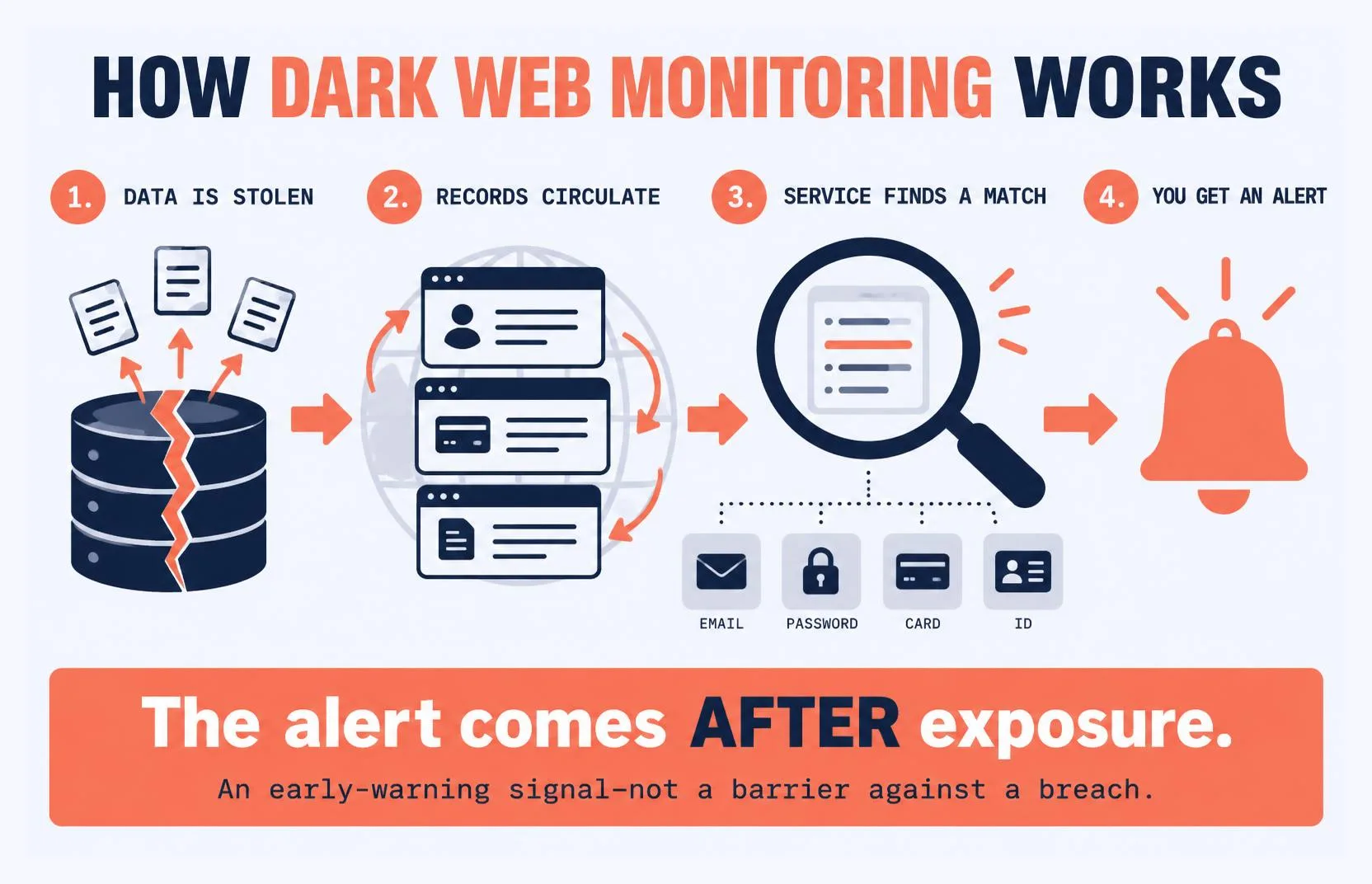
When a company you use gets breached, the stolen records often end up in these markets or in large data dumps that circulate among criminals. That is the material dark web monitoring is built to search.
What Dark Web Monitoring Actually Does
A dark web monitoring service scans known marketplaces, forums, and breach databases for identifiers you give it, such as your email addresses, phone numbers, Social Security number, and card numbers. When it finds a match, it sends you an alert telling you what was found and, usually, which breach or source it came from.
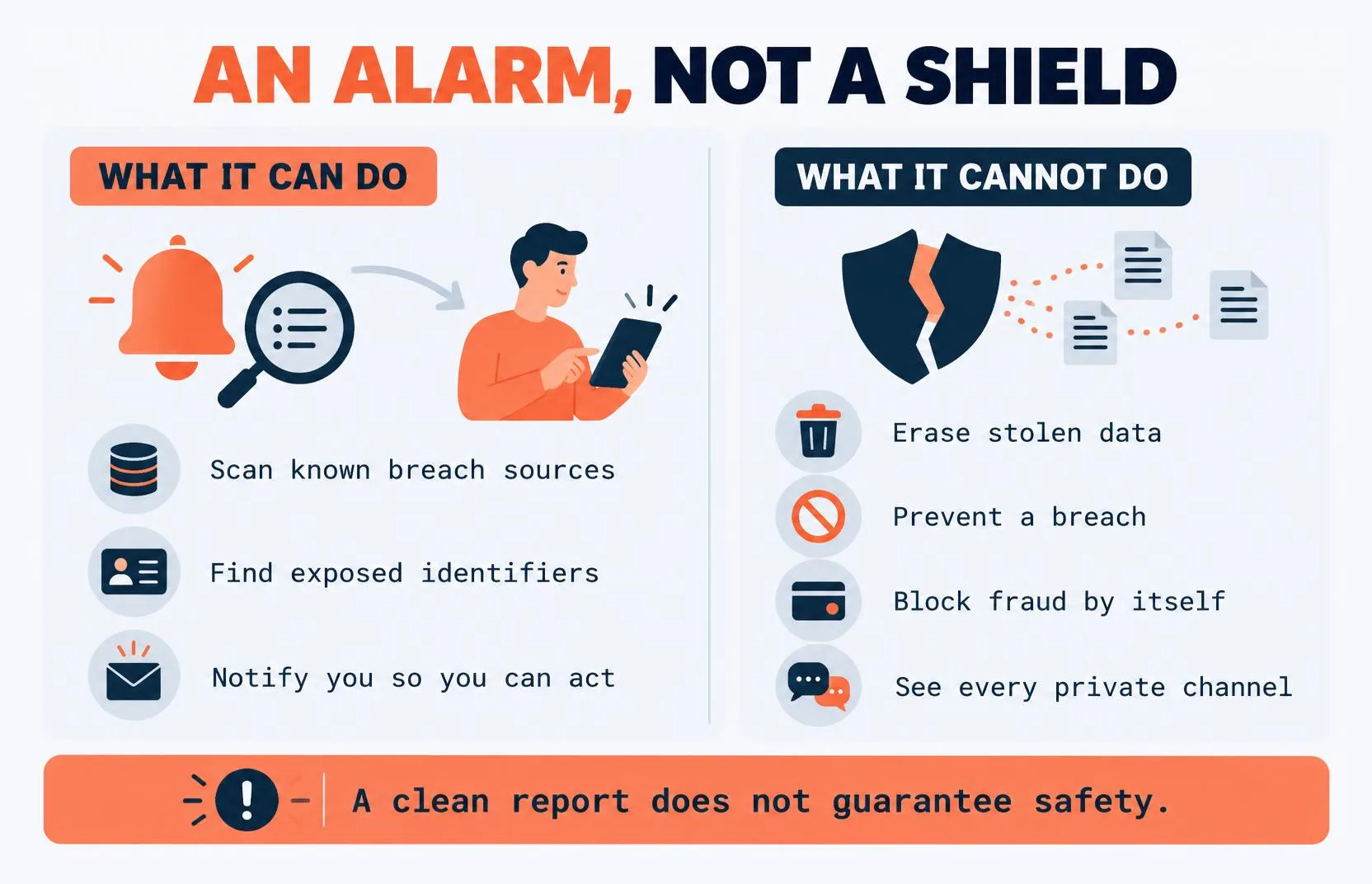
That is the whole function: it searches, and it notifies. It is an early-warning system for exposure that has already happened. It does not sit between criminals and your data, and it does not prevent a breach. It tells you after the fact that your information is out there, so you can react.
What It Finds, and What That Means
The alerts generally fall into a few categories, and the right response depends on which you get.
| What the alert shows | What it usually means | How urgent |
|---|---|---|
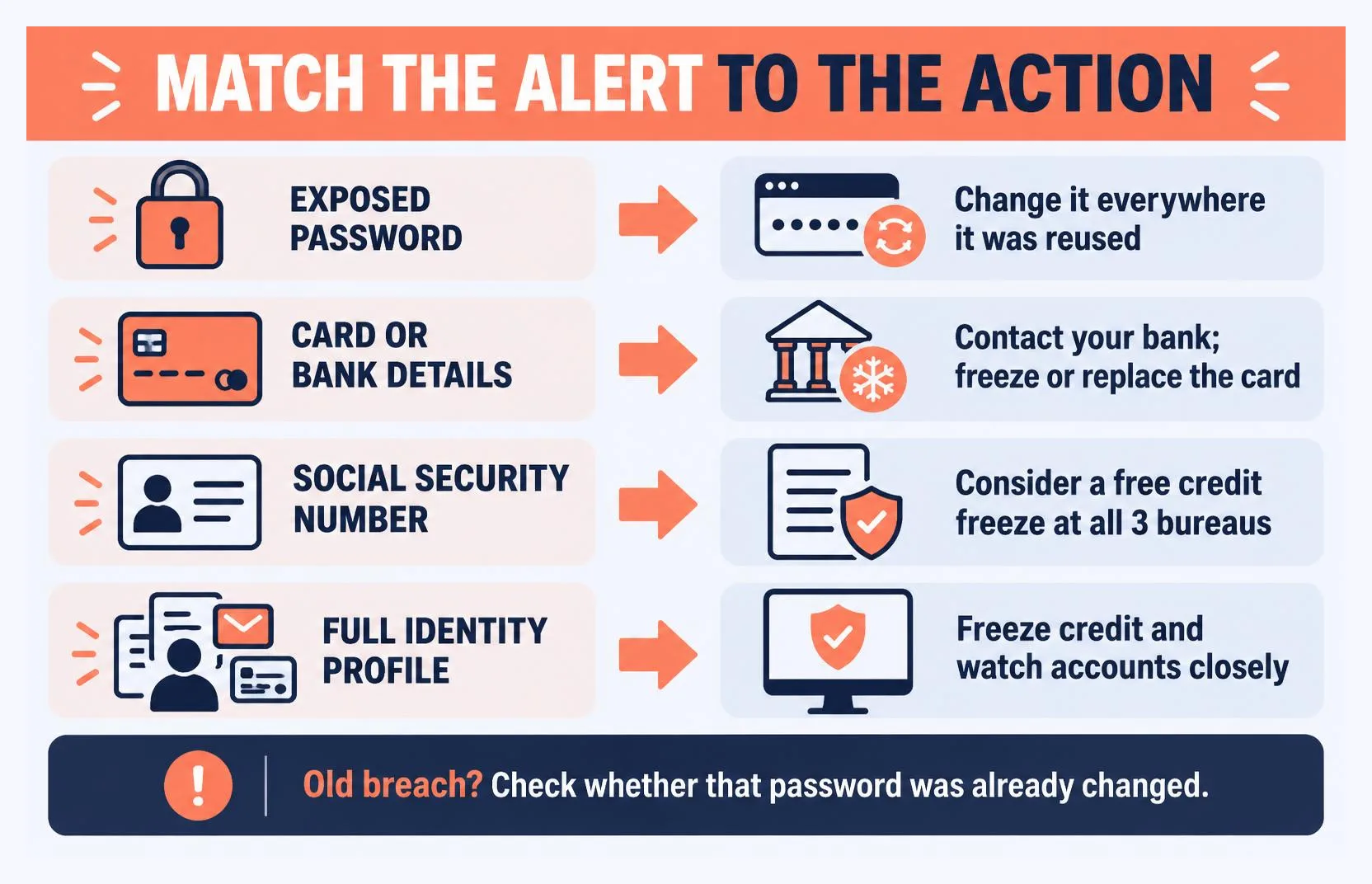
| Email in a breach | A site you used was breached; your email and possibly a password leaked | Moderate: change that password |
| Password exposed | A specific password is public; any account reusing it is at risk | High: change it everywhere it was reused |
| Credit card number | Card data is circulating; fraud may follow | High: call your bank, freeze or replace the card |
| Social Security number | A core identity element is exposed; identity-theft risk | High: consider a credit freeze |
| Full profile for sale | Multiple details bundled together | High: freeze credit, watch accounts closely |
One important nuance: a large share of what monitoring finds comes from old, already-public breaches. Seeing your email in a 2019 breach is not a new emergency if you already changed that password years ago. The value is in the alerts you did not already know about.
What It Cannot Do
This is where the marketing and the reality separate, and it is the part worth understanding before you pay.
- It cannot remove anything from the dark web. Once data is copied, sold, and spread across criminal markets, there is no delete button. No service can pull it back. Monitoring only tells you it is there.
- It does not prevent breaches or fraud. It is a smoke detector, not a lock. It reports exposure that already happened; it does not stop the next one.
- It misses what it cannot see. Much criminal activity happens in private channels and closed forums that no scanner fully reaches, so a clean report is not a guarantee you are safe.
- It can create false comfort. The biggest risk is treating “dark web monitoring” as “identity protection” and doing nothing else, when the alert is only useful if you act on it.
Be skeptical of any service that claims it will remove your information from the dark web. That is not technically possible. What you can control is the fallout: changing exposed passwords, freezing credit, and reducing how much of your data is publicly available to be stolen in the first place.
So Is It Worth It?
For most people, yes, but only at the right price and with the right expectations. The honest value breakdown looks like this.
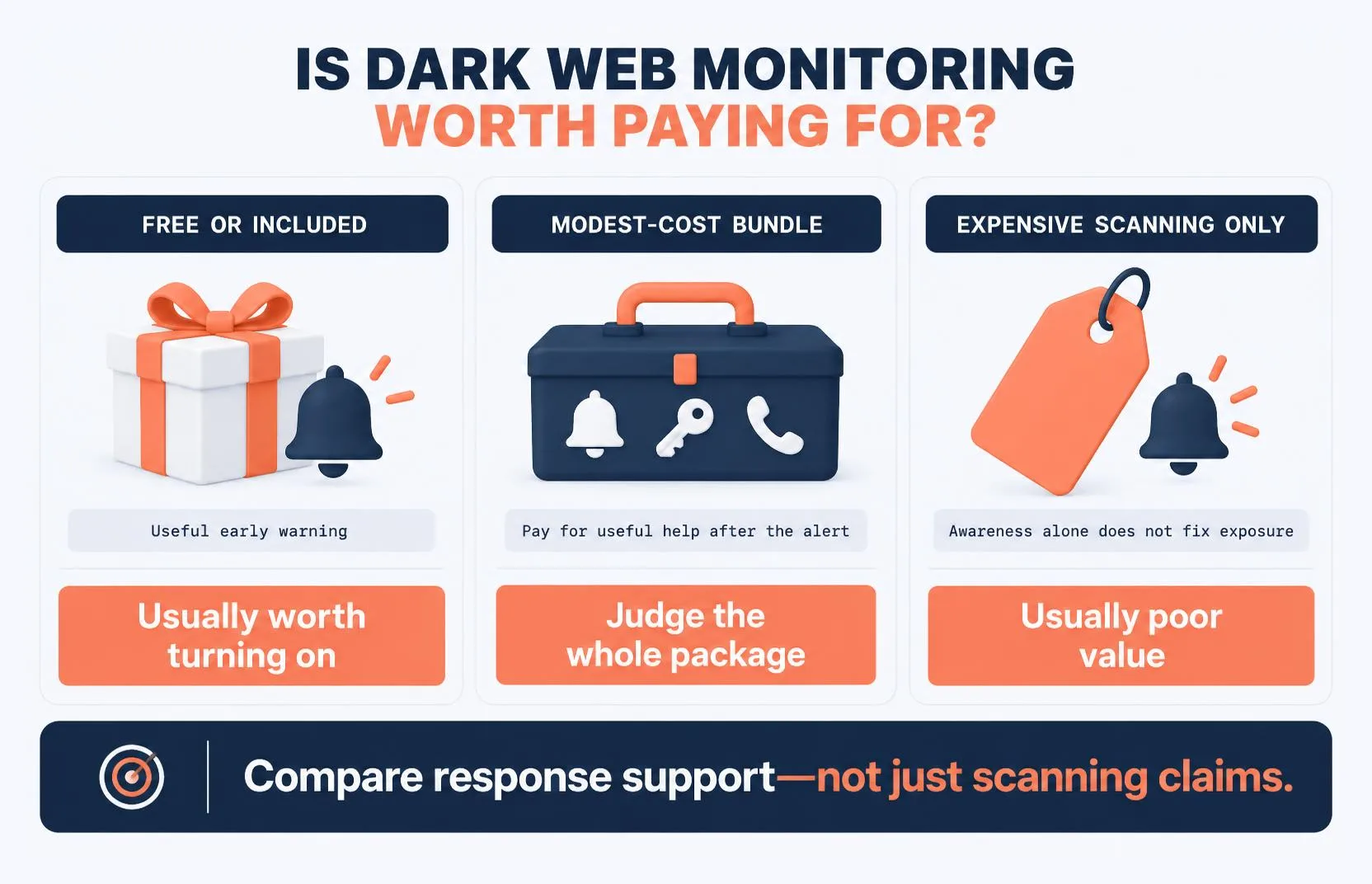
Worth it when it is free or already included. Many banks, credit cards, and services like Google One bundle dark web or breach monitoring at no extra cost. As a free early-warning layer, it is worth turning on. There is little reason to skip a free alert that might catch an exposed password.
Worth a modest amount as part of a bundle. If it comes inside a broader identity-protection or privacy plan you already want, it adds a useful signal. The monitoring itself is not the valuable part; what the plan does with the alert is.
Not worth paying a premium for on its own. Paying a high standalone price purely for dark web scanning is rarely justified, because you can get much of the same signal free, and the scanning does not fix anything. You would be paying for awareness you can largely get elsewhere.
Dark web monitoring is a useful, low-cost alarm, not a shield. Turn on the free version, do not overpay for a standalone product, and judge any paid plan by what it helps you do after an alert, not by the scanning itself.
See What Is Already Public About You
Dark web monitoring watches for stolen data. The data brokers and people-search sites exposing your name, address, and phone number are a bigger and more fixable problem. NewReputation’s free scan shows where you are listed right now.
- Find the sites publishing your personal information
- See what a stranger finds when they look you up
- Free scan, no obligation
What to Do When You Get an Alert
The alert is only the start. These are the steps that actually reduce the damage, in order of priority.
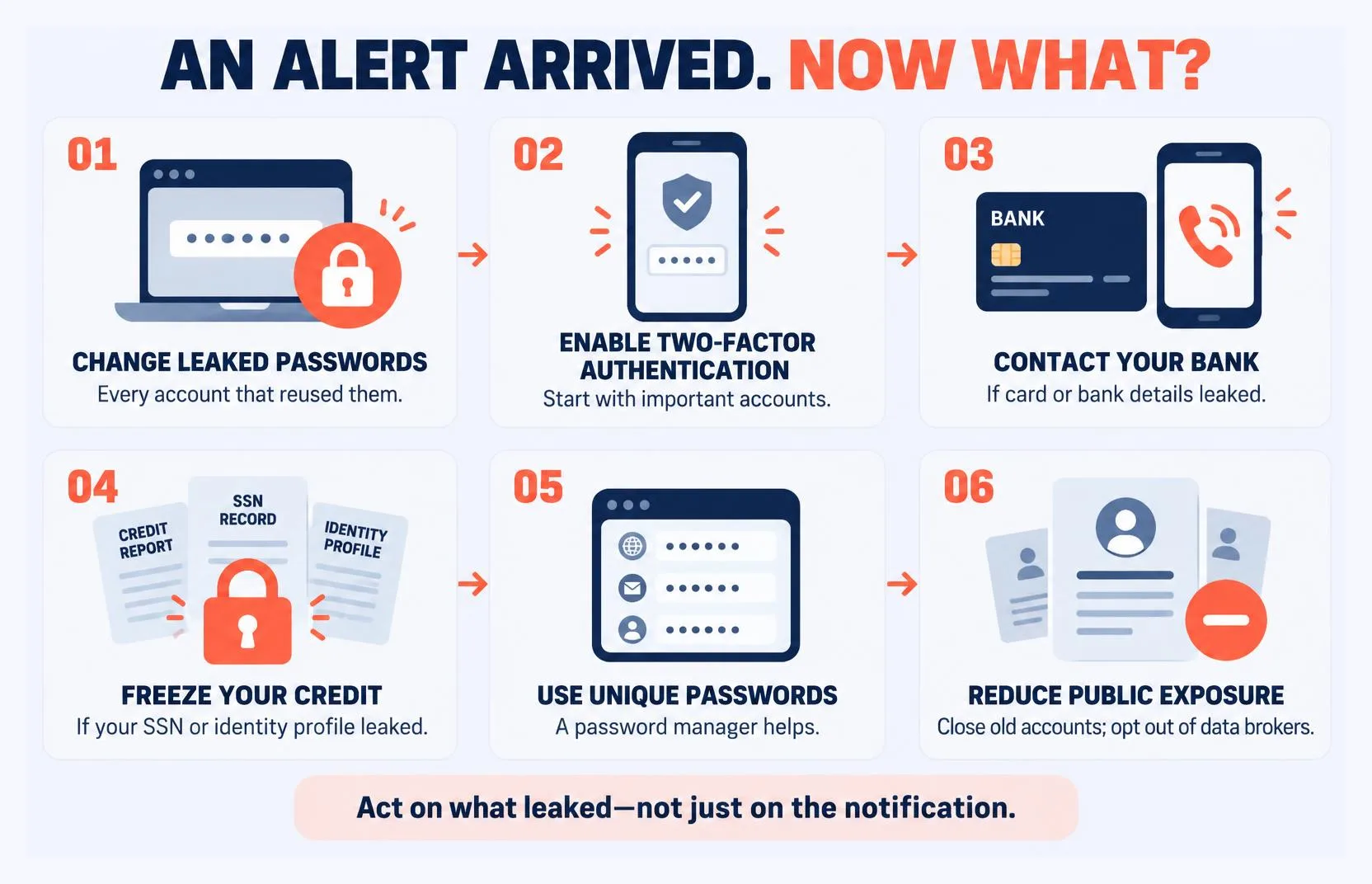
- Change the exposed password immediately, and change it anywhere else you reused it. Password reuse is what turns one leaked login into many compromised accounts.
- Turn on two-factor authentication for the affected account and your important accounts generally. Even a leaked password is far less dangerous when a second factor is required.
- If a card or bank detail leaked, contact the bank, and freeze or replace the card. Watch statements for unfamiliar charges.
- If your Social Security number leaked, consider a credit freeze with the three bureaus. It is free and blocks most new-account fraud.
- Use a password manager so every account has a unique password, which contains the damage of any future leak to a single account.
- Reduce your exposed data so there is less to steal next time. Our guide on finding every account tied to your email helps you close old accounts that are quietly holding your data.
You can search your own email against known breaches for free using reputable breach-notification tools, which cover much of what paid dark web monitoring reports. If you find exposure, the response steps above are the same whether a free tool or a paid service flagged it.
Monitoring vs Actually Reducing Your Exposure
Dark web monitoring watches for data that has already been stolen. It pairs with, but does not replace, the work of reducing how much of your information is publicly available in the first place. The less of your data that is floating around in people-search sites and data brokers, the less there is to end up in a breach or a dark web dump.
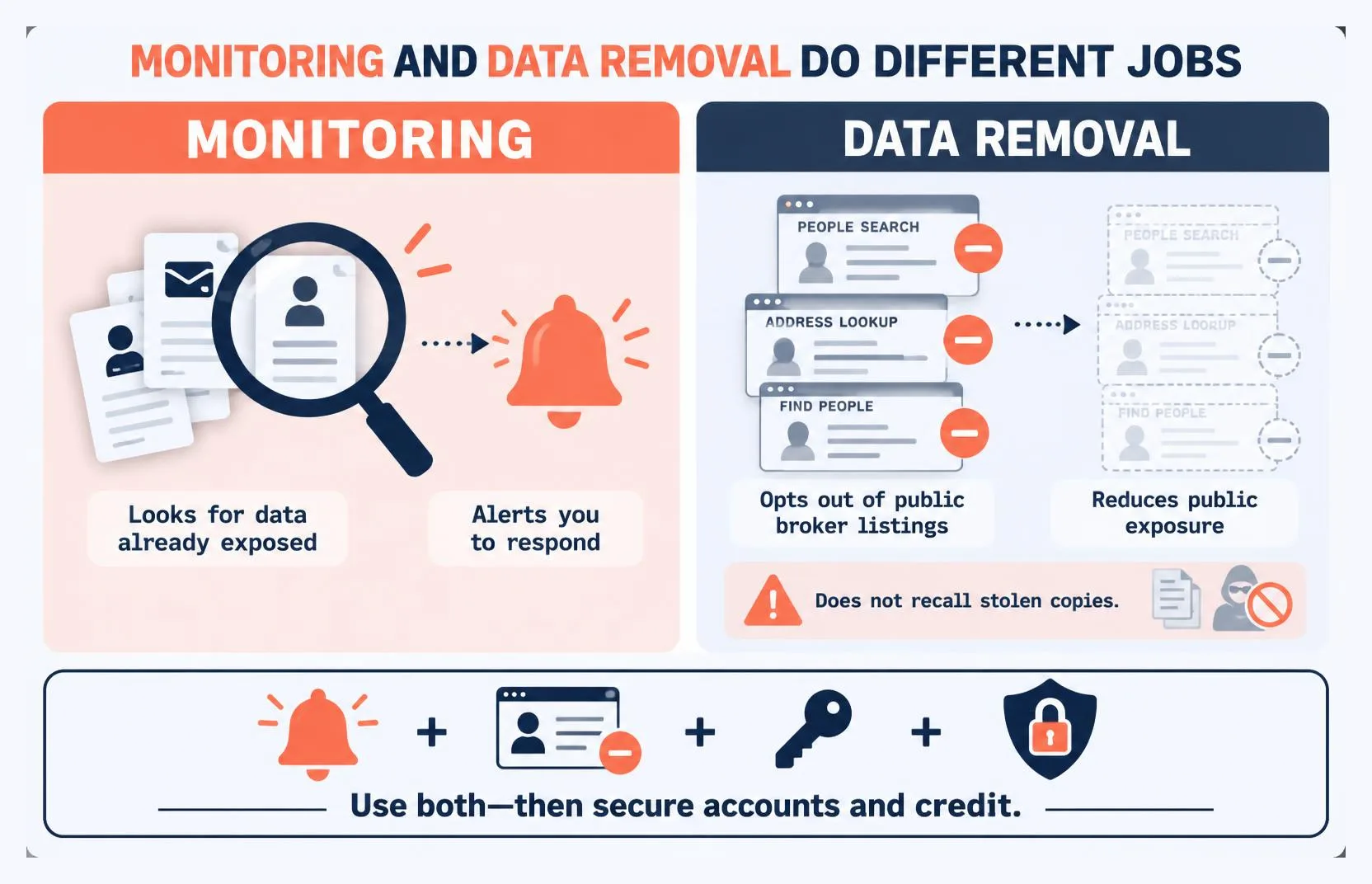
That is the difference between being alerted and being protected. Monitoring tells you about a problem; removing your data from the places that publish it shrinks the problem. For the full picture of how these fit together, see our guide on personal data monitoring vs data removal, and the practical steps in how to remove personal information from the internet and how to protect your online privacy.
Frequently Asked Questions
Can dark web monitoring remove my information from the dark web?
No. Once data has been stolen and spread across dark web marketplaces, it cannot be deleted or recalled, and no legitimate service can remove it. Dark web monitoring only scans for your information and alerts you when it appears. Any service claiming it can erase your data from the dark web is misrepresenting what is technically possible. What you can do is respond to the exposure by changing passwords, freezing credit, and reducing the personal data you have publicly available.
Is free dark web monitoring good enough?
For most people, yes. Many banks, credit cards, and services like Google One include dark web or breach monitoring at no cost, and free breach-notification tools let you check your email against known leaks yourself. These cover much of what paid services report. The paid version is mainly worth it when it is bundled with broader identity protection or privacy services you already want, since the monitoring itself is similar whether free or paid.
What should I do if my information is found on the dark web?
Act based on what leaked. Change the exposed password immediately and anywhere you reused it, and turn on two-factor authentication. If a card or bank detail was exposed, contact your bank and replace the card. If your Social Security number was exposed, place a free credit freeze with the three bureaus. Then use a password manager for unique passwords going forward, and reduce your publicly available data so there is less to steal next time.
Does dark web monitoring prevent identity theft?
Not by itself. It is an early-warning system that tells you after your data has already been exposed, so you can react faster. It does not prevent breaches, block fraud, or stop criminals from using leaked data. It reduces the time between exposure and your response, which can limit damage, but prevention comes from the actions you take, such as freezing credit, using strong unique passwords, and minimizing your exposed information.
Is dark web monitoring a scam?
The legitimate versions are not a scam, but the marketing often overpromises. Reputable services do scan criminal markets and breach data and send real alerts, which has genuine value as a warning. The misleading part is any claim to remove your data from the dark web or to fully protect your identity, neither of which monitoring can do. Judge a service by whether it is honest about those limits and by what it helps you do after an alert.
How is dark web monitoring different from data removal?
Dark web monitoring watches criminal marketplaces for data that has already been stolen and alerts you. Data removal opts you out of the people-search sites and data brokers that legally publish your information, so there is less of your data publicly available to be scraped or stolen in the first place. Monitoring is reactive awareness; removal is proactive reduction of your exposure. They work best together, with removal shrinking the target and monitoring watching for what still gets out.
Shrink the Target Before It Gets Stolen
You cannot delete data from the dark web, but you can remove it from the public sites that feed the breaches. NewReputation removes your information across hundreds of data brokers and people-search sites and monitors so it stays down.
- Removal across hundreds of sites, handled for you
- Less public data means less to end up in a breach
- Ongoing monitoring so it does not resurface
This article provides general information about privacy and security services and is not legal or financial advice. If you believe you are a victim of identity theft, report it at IdentityTheft.gov.