
Last Updated on 39 minutes ago by Admin
Data removal deletes your personal information from data brokers and people-search sites, so it stops showing up. Personal data monitoring watches those same sources and alerts you when your information appears, but it does not take anything down. In short, removal reduces your exposure and monitoring reports on it. For real privacy you want both, but removal is the foundation: monitoring only warns you, while removal is what actually gets your data off the internet. Start with removal, then monitor to catch anything that comes back.
Privacy companies sell two very different things under similar-sounding names, and the difference decides whether your personal information actually comes off the internet or just gets watched. If you have looked at services that promise to protect your data, you have seen both words, often bundled together, rarely explained. This guide breaks down what each one really does, where each falls short, and how to combine them so you are not paying to be alerted about a problem no one is fixing.
Table of Contents
What Data Removal Actually Does
Data removal is the active work of getting your personal information taken off the sites that publish it. That means submitting opt-out requests to people-search sites like Whitepages and Spokeo, and to the data brokers that feed them, so your name, address, phone number, relatives, and other details are deleted from their profiles.
The result is concrete: the listing that showed your home address is gone, so a stranger searching your name no longer finds it there. Removal is the only one of the two approaches that reduces your actual exposure. Everything else, including monitoring, is built around it.
The catch is that removal is not permanent by itself. Data brokers rebuild their records from public sources, so information you remove can reappear within a few months. That is exactly the gap monitoring is meant to fill. For the full process, see our guide on how to remove personal information from the internet, and the site-by-site data broker opt-out guides.
What Personal Data Monitoring Actually Does
Personal data monitoring is surveillance of your own exposure. A monitoring service continuously scans data brokers, people-search sites, and sometimes breach databases and the dark web, then alerts you when your information turns up. It is an early-warning system, not a cleanup crew.
Monitoring is genuinely useful, but only for what it is: awareness. It tells you that your data reappeared on a broker after you opted out, that your email showed up in a new breach, or that a new people-search listing was created. What it does not do, on its own, is remove any of it. A pure monitoring alert leaves the actual removal work to you.
This is the distinction that trips people up. Identity-theft products such as credit and dark-web monitoring are monitoring, not removal. They watch and notify. If you want the information gone, something or someone still has to file the opt-out.
Side by Side: Monitoring vs Removal
Here is the difference at a glance.
| Data removal | Personal data monitoring | |
|---|---|---|
| What it does | Deletes your information from brokers and people-search sites | Watches those sources and alerts you when your data appears |
| Effect on exposure | Reduces it: the listing comes down | None on its own: the listing stays up until removed |
| Main benefit | Your data is actually gone | You know when something changes |
| Main limitation | Not permanent; brokers repopulate | Alerts you to a problem it does not fix |
| Best for | Getting exposure down now | Catching new exposure early |
| Works best when | Paired with ongoing monitoring | Paired with removal that acts on the alerts |
Read down the table and the relationship is clear: they are not competitors, they are two halves of the same job. Removal handles the exposure you have today; monitoring catches the exposure you get tomorrow.
Which One Do You Need?
For most people the honest answer is both, but in a specific order. Removal comes first, because there is no point being alerted about data that is already out there if nothing is removing it. Monitoring comes second, to catch what returns.
If you can only start with one, start with removal. A pile of alerts about your exposed address does nothing to protect you; taking the address down does. Once your current exposure is cleaned up, monitoring earns its place by watching for the inevitable reappearance.
Ask any service one question: “Do you remove my data, or do you only tell me where it is?” If the answer is only alerts, you are buying monitoring, and you will still need removal to change anything. Many identity-protection plans are monitoring dressed up as protection.
See What Is Exposed Before You Decide
Monitoring and removal both start with knowing where you are listed. NewReputation’s free scan shows the data brokers and people-search sites publishing your information right now.
- Find the sites exposing your name, address, and phone
- See what a stranger finds when they look you up
- Free scan, no obligation
How They Work Together
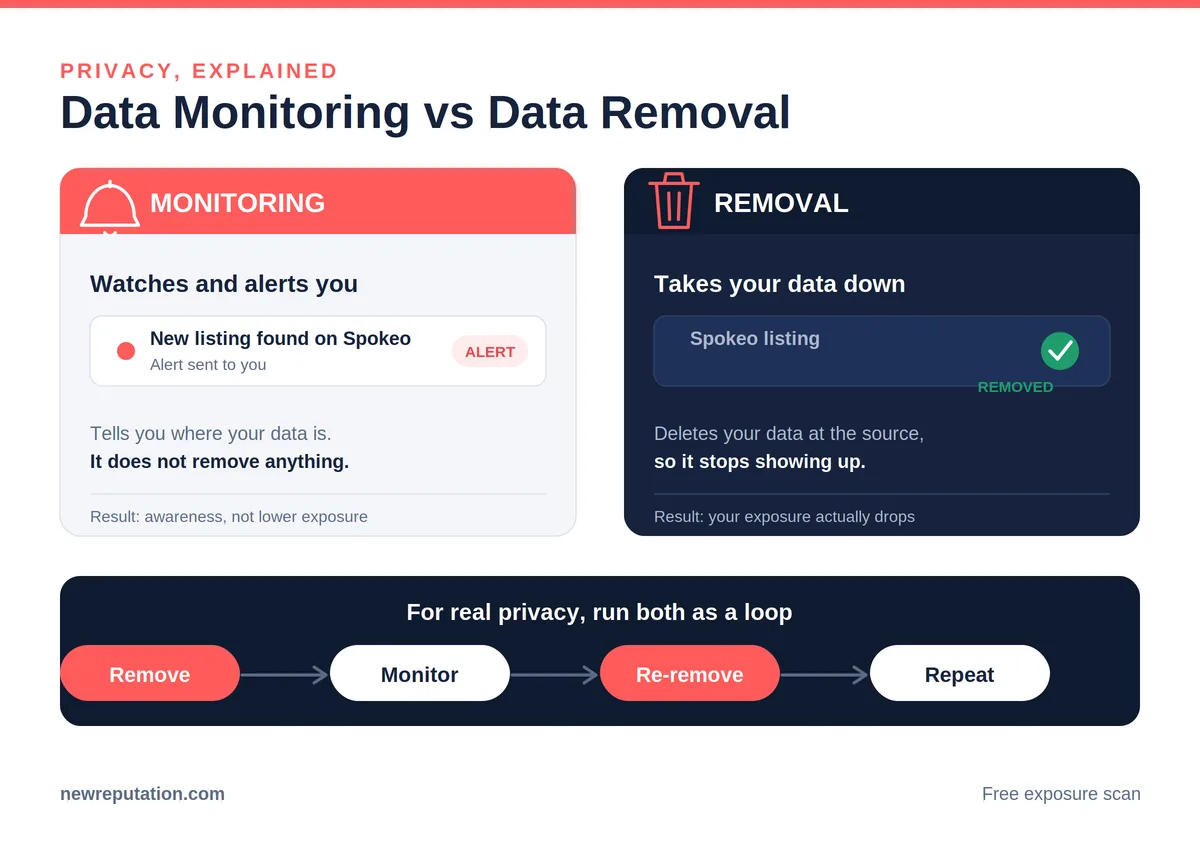
The two approaches are strongest as a loop, and privacy holds up only when both halves run. Here is the cycle that keeps your exposure down over time.
- Remove. Opt out of the people-search sites and data brokers publishing your information, starting with the largest. This is the step that lowers your exposure.
- Monitor. Once you are clean, scan those same sources on a schedule so you know the moment your data reappears.
- Re-remove. When monitoring flags a reappearance, file the opt-out again. Brokers repopulate, so this is expected, not a failure.
- Repeat. Recheck quarterly. Privacy is a maintenance routine, not a one-time purchase.
Monitoring without removal is an alarm with no responder. Removal without monitoring is a clean slate that quietly refills. Run together, they keep your exposure low with far less effort than either alone. Our guide on how to protect your online privacy puts this routine in the wider context of everything else worth locking down.
What to Look For in Each
If you are comparing paid services, judge them on what they actually deliver, not the marketing.
In a data removal service
- Breadth of coverage. How many brokers and people-search sites does it actually opt you out of? The long tail matters, because the small sites feed the big ones.
- Upstream brokers. Does it reach the large aggregators, not just the consumer-facing sites? Opting out upstream slows how fast the others repopulate.
- Re-removal. Does it re-file when your data comes back, or only run once? Ongoing removal is the whole point.
- Proof. Does it show you what it found and what it removed, so you can verify the work?
In a monitoring service
- What it scans. People-search sites, breach databases, the dark web, or all three? Broader scanning catches more.
- Alert quality. Are alerts specific and actionable, or vague noise you learn to ignore?
- What happens next. Does an alert connect to removal, or does it stop at telling you? This is the line between monitoring and protection.
To see how far your legal removal rights reach, our guides on data broker deletion rights by state and California’s DROP platform cover what you can force a broker to do for free.
Common Mistakes to Avoid
A few predictable errors waste money and leave people exposed while feeling protected.
- Assuming monitoring removes anything. It does not. If your plan only sends alerts, your data is still up. This is the single most common misunderstanding.
- Confusing credit monitoring with privacy. Credit and identity-theft monitoring watch for fraud. They do not remove your address and phone number from people-search sites, which is a separate exposure.
- Removing once and stopping. A one-time cleanup feels done, but brokers repopulate within months. Without monitoring and re-removal, you are back where you started by next year.
- Ignoring the source of your data. If your home address keeps flowing through public filings, brokers keep getting it. Prevention, covered in our personal information removal guide, matters as much as cleanup.
Doxxing and harassment raise the stakes on all of this, because the delay between exposure and response can be dangerous. If that is your situation, our guide on what to do about doxxing covers the faster, safety-focused steps.
Frequently Asked Questions
Is personal data monitoring the same as data removal?
No. Data removal deletes your personal information from data brokers and people-search sites, so it stops appearing. Personal data monitoring only scans those sources and alerts you when your information shows up; it does not take anything down. Monitoring tells you about your exposure, removal reduces it. They are complementary, but only removal actually changes what is public about you.
Do I need both monitoring and removal?
For most people, yes, and in that order. Removal gets your current exposure down, and monitoring catches it when brokers repopulate so you can remove it again. If you can only do one first, choose removal, because being alerted to exposed data does nothing to protect you unless something removes it. Monitoring is most valuable once your data is already cleaned up.
Does identity theft protection remove my information from the internet?
Usually not. Most identity-theft protection is monitoring: it watches your credit, breach databases, and sometimes the dark web, then alerts you to suspicious activity. That is useful for catching fraud, but it does not opt you out of the people-search sites and data brokers publishing your name, address, and phone number. Removing that information is a separate service, so check whether your plan actually files opt-outs or only sends alerts.
If a service removes my data, why do I still need monitoring?
Because removal is not permanent. Data brokers continuously rebuild their databases from public records and other sources, so information you remove can reappear within weeks or months. Monitoring watches for that reappearance and tells you when to re-file the opt-out. Without it, you would have to manually recheck dozens of sites yourself to notice your data came back.
Which is cheaper, monitoring or removal?
It varies by provider, and many services bundle the two, so a direct price comparison is difficult. The more useful question is what you are paying for: a monitoring-only plan may be inexpensive but leaves the removal work to you, while a removal service does the labor that actually lowers your exposure. Judge the value by outcomes, not just the monthly price, and confirm whether removal is included or only alerts.
Can I do both myself for free?
Yes, though it takes time. You can opt out of the major people-search sites yourself using free step-by-step guides, and you can monitor by searching your own name and setting Google Alerts. The tradeoff is hours of work across dozens of sites, repeated every quarter, since brokers repopulate. A paid service automates the same steps at scale; the underlying process is identical.
Removal and Monitoring, Handled Together
NewReputation removes your information across hundreds of data brokers and people-search sites, then monitors continuously and re-removes anything that comes back, so you are not just watching your exposure, you are lowering it.
- Removal across hundreds of sites, done for you
- Ongoing monitoring with automatic re-removal
- Proof of what was found and taken down
This article provides general information about privacy services and is not legal advice. Removal rights and data broker obligations vary by state.

West Virginia alumni with a background in marketing and sales for both established companies and startups.