
Last Updated on 5 months ago by Admin
Writing about your professional background and having it prepared beforehand is a great way to introduce When people Google you, your bio is often the first thing they see.
Your bio is everywhere: on LinkedIn, your website, in pitch decks, and even in podcast intros. It provides answers to three key questions:
- Who are you?
- Why should I care?
- Can I trust you?
Yet most of us either overthink it and freeze… or rush it and sound like everyone else.
In this post, I’ll show you how I write a professional bio. This includes bios for myself, clients, and teams. You’ll find practical examples that you can copy, paste, and adjust as needed.
Why your bio actually matters
A professional bio isn’t just a vanity exercise. It’s part of your personal SEO.
- LinkedIn has over 1 billion members (Microsoft FY25 Q1). Your headline and “About” section are heavily indexed in search.
- Recruiters mainly use LinkedIn for sourcing. Over 90% report finding candidates there, according to various surveys.
- If you speak, consult, freelance, or create content, your bio is often used by organizers and editors on their sites.
So a strong bio:
- Gets you found (searchable keywords)
- Makes you memorable (clear positioning)
- Builds trust (proof, not fluff)
Think of it as your always-on elevator pitch.
Start with the format: where will this bio live?
You don’t need one perfect bio. You need a small toolkit:
- 1-line bio – For social media headers, bylines, email signatures
- Short bio (40–60 words) – For intros, panels, mini “About” sections
- Medium bio (100–150 words) – For LinkedIn About, company sites
- Long bio (200–300+ words) – For personal sites, speaker pages
I usually write the medium version first, then trim down or expand.
Step 1: Decide your positioning in one sentence
Before you write anything, finish this sentence in plain English:
I’m a _____ who helps _____ do/achieve _____.
Examples:
- “I’m a product marketer who helps SaaS companies turn features into stories that sell.”
- “I’m a software engineer who helps startups turn messy ideas into stable, scalable products.”
- “I’m a career coach who helps mid-career professionals get unstuck and land roles they actually want.”
This is your anchor sentence. Your whole bio will orbit this.
If you’re multi-passionate, pick one primary lane for this specific bio. You can always write different bios for different audiences.
Step 2: Choose your bio voice (formal vs. casual)
You’ve got two main options:
1. Third person (more formal)
“Donald is a marketing strategist who…”
This is common for company sites, speaker bios, events, and formal contexts.
2. First person (more personal)
“I’m a marketing strategist who…”
This works really well on LinkedIn, personal websites, and anywhere you want to feel more human and approachable.
Since you asked me to write like I speak, I’ll keep everything in first person, and you can convert it to third person if needed.
Simple conversion tip:
- “I help B2B brands…” → “Donald helps B2B brands…”
- “I’ve worked with…” → “He has worked with…”
Step 3: Build your core structure
Here’s a simple structure I use for most bios:
- Opening line – Who you are + who you help + how you help
- Credibility – Experience, results, companies, education (if relevant)
- Proof – Numbers, outcomes, or specific projects
- Personality – A line that shows you’re a human, not a robot
- Call to action – How people can work with you or why they should connect
Let’s break that down.
Step 4: Write your opening line
Your first sentence should be:
- Clear, not clever
- Focused on what you actually do now (not your entire history)
- Understandable to a non-expert
Instead of:
“I’m a visionary, results-driven professional with a proven track record of success.”
Try:
“I’m a [role] who helps [type of people/companies] [accomplish what].”
A few realistic examples:
- “I’m a project manager who helps cross-functional teams deliver complex projects on time and with less chaos.”
- “I’m a UX designer who turns confusing software into simple, usable experiences.”
- “I’m an operations leader who helps small businesses create systems so the business can run without burning everyone out.”
Write 3–5 versions of this line for yourself. The first one is rarely the best.
Step 5: Add credibility without bragging
This is where you answer: “Why should anyone believe me?”
Credibility can come from:
- Years of experience
- Industries you’ve worked in
- Well-known companies or clients
- Certifications or degrees (when relevant)
- Notable projects or achievements
Formats you can use:
- “Over the past 7 years, I’ve…”
- “Previously, I’ve worked with…”
- “I’ve led projects for…”
- “My background spans X, Y, and Z.”
Example:
“Over the last 8 years, I’ve led product launches, rebrands, and go-to-market campaigns for B2B SaaS companies. These include early-stage startups and global teams.””
If you’re earlier in your career, lean into:
- What you’re learning
- What you’ve shipped
- The kind of problems you like solving
Example for someone earlier in their career:
“I’ve done internships with both agency and in-house teams. I supported social campaigns, email marketing, and basic analytics reporting.””
No need to oversell. Clarity beats hype.
Step 6: Add proof and results (with or without big numbers)
Bios with specific outcomes feel more trustworthy.
If you have numbers, use them:
- “Increased qualified leads by 30% in 6 months.”
- “Managed a $500k annual marketing budget.”
- “Led a team of 10 across 3 time zones.”
If you don’t have clear metrics, use concrete outcomes:
- “Helped launch a new onboarding process now used across the company.”
- “Created documentation that reduced support tickets for common issues.”
- “Designed dashboards that gave leadership real-time visibility into revenue.”
Example paragraph:
“I recently led a project to redesign our onboarding. This helped new customers see value faster and boosted activation rates. I also built reporting dashboards that helped our sales and marketing teams make faster decisions with real data.”
If you’re changing careers, you can:
- Connect previous achievements to your new direction
- Highlight transferable skills (communication, analysis, leadership, systems thinking)
Step 7: Show you’re a real person
This is the part most people skip—and it’s where your bio can stand out.
One or two lines is enough:
- “Outside of work, you’ll usually find me [doing what].”
- “When I’m not [work thing], I’m probably [personal thing].”
- “I care deeply about [values, causes, or interests].”
Examples:
- “Outside of work, you’ll usually find me reading sci-fi, learning new no-code tools, or trying to make the perfect cup of coffee.”
- “I care a lot about making work feel more human, especially for remote teams.”
The goal isn’t to be quirky for the sake of it. It’s to give people one human detail they might remember you by or connect with.
Step 8: Add a simple call to action
What do you want people to do after reading your bio?
- Connect with you
- Reach out about roles
- Book you for speaking or consulting
- Collaborate on projects
Add a clear, low-pressure line:
- “If you’re working on [type of thing], I’m always happy to connect.”
- “I’m currently open to [roles/opportunities].”
- “The best way to reach me is via [email/LinkedIn/etc.].”
Example:
“I’m always open to connecting with people working on thoughtful products and teams that care about meaningful work. The best way to reach me is on LinkedIn.”
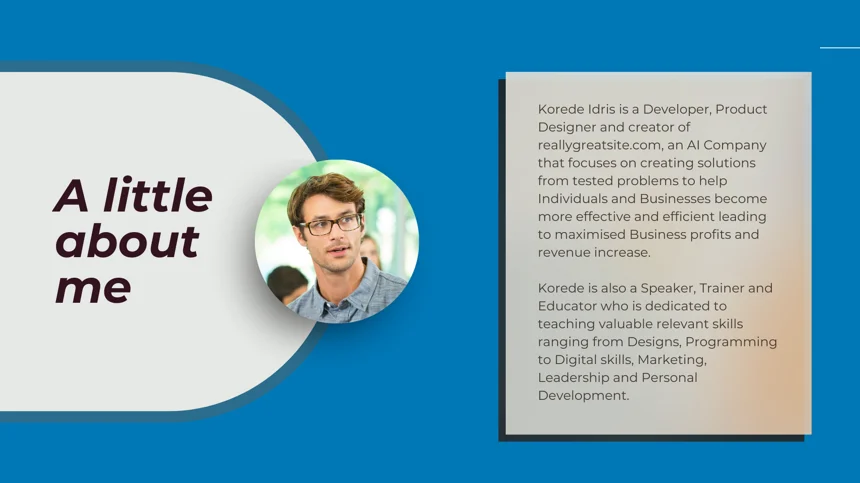
1)Putting it all together: fill-in-the-blank templates
Short first-person bio (40–60 words)
I’m a [role] who helps [audience] [achieve X]. Over the past [X] years, I’ve worked with [types of companies/industries] on [key projects]. I’m especially interested in [specific focus]. When I’m not working, I’m usually [personal detail]. I’m currently open to [opportunities/collaboration type].
Example:
I’m a content strategist who helps B2B tech companies turn complex ideas into clear, useful content. Over the past 6 years, I’ve worked with startups and mid-size teams on blogs, playbooks, and product launches. Outside of work, you’ll find me reading long-form essays or walking with a podcast. I’m open to fractional content leadership roles.
Medium first-person bio (100–150 words)
I’m a [role] who helps [audience] [achieve what]. Over the past [X] years, I’ve worked across [industries] with [types of organizations]. My work focuses on [specific skills or types of projects]. I’ve [built/led/delivered] [notable outcomes, with numbers if possible].
I’m especially interested in [areas of focus or values]. I care about [what matters to you in your work]. Outside of work, I’m often [personal detail], [personal detail], or [personal detail].
I’m currently [role status: e.g., leading X at Y / exploring new opportunities / open to consulting]. If you’re working on [relevant area], I’m always happy to connect.
You can copy this and fill in the blanks in your own words.
Third-person conversion example
First person:
I’m a data analyst who helps product and marketing teams turn noise into actionable insights. In the last 5 years, I’ve worked in e-commerce and SaaS. I built dashboards, ran experiments, and partnered with stakeholders. This helped us make better, data-driven decisions.
Third person:
Donald is a data analyst who helps product and marketing teams turn noise into actionable insights. In the last 5 years, he has worked in e-commerce and SaaS. He built dashboards, ran experiments, and partnered with stakeholders. This helped teams make better, data-informed decisions.
Same content, different voice.
Common mistakes I see in bios (and how to fix them)
1. Buzzword soup
“Results-oriented, dynamic, innovative, detail-oriented professional…”
Fix: Replace generic adjectives with specific outcomes.
- Instead of: “results-oriented” → “I’ve led campaigns that increased trial-to-paid conversion rates.”
2. Your resume copied into a paragraph
Your bio is not your full work history.
Fix: Pull out themes:
- What do you keep doing across roles?
- What problems do people keep asking you to solve?
Turn that into 2–3 sentences.
3. Apologizing or shrinking yourself
Especially common when people are changing careers or feel “non-traditional”.
Fix: Focus on what you bring, not what you lack.
- “After 10 years in hospitality, I bring strong customer empathy, conflict resolution, and operations experience to my work in customer success.”
4. Being too vague
“I’m passionate about business, people, and technology.”
Fix: Show, don’t tell.
- “I enjoy working at the intersection of people, process, and technology. I build systems that make daily tasks feel easier and more organized.””
How to make your bio more discoverable (SEO basics)
A quick SEO layer can help the right people actually find you.
- Use the words people search for, not internal job titles.
- Instead of “Customer Happiness Ninja” → “Customer Support Specialist” or “Customer Success Manager”.
- Include your core skills and tools.
- “I work with Python, SQL, and Tableau.”
- “Experienced with Figma, usability testing, and design systems.”
- Add your location / market if relevant.
- “Based in Austin, open to remote roles across the US.”
- Repeat your main keyword naturally.
- If you want to be found as a “freelance content writer,” use that phrase clearly.
You don’t need to stuff keywords. Just make sure the words that matter actually appear.
A simple 20-minute workflow
If you want a quick, practical way to do this today, here’s what I’d do:
- 5 minutes – Brain dump Write messy answers to:
- What do I actually do day to day?
- Who do I want to work with?
- What am I good at that others rely on me for?
- What am I most proud of in my work so far?
- 5 minutes – Draft your anchor sentence “I’m a ___ who helps ___ do ___.” Write 3–5 versions and pick the clearest one.
- 5 minutes – Build a 4–5 sentence bio Use this mini-structure:
- Sentence 1: Who you are and who you help
- Sentence 2: Credibility (years, industries, types of work)
- Sentence 3: Proof (results or tangible projects)
- Sentence 4: Personality (one human detail)
- Sentence 5: Call to action
- 5 minutes – Edit for clarity
- Remove buzzwords
- Replace long phrases with simple ones
- Read it out loud. If you wouldn’t say it, rewrite it.
One more done-for-you example
Here’s a complete, realistic first-person bio you can use as inspiration and adapt to your world:
I’m a customer success manager who helps B2B SaaS teams turn new signups into long-term, happy customers. In the last 6 years, I’ve helped startups and mid-size companies. I worked on onboarding journeys. I aimed to cut churn and strengthen relationships with key accounts.
I’ve led projects for clients in fintech, HR tech, and e-commerce. I work closely with sales, product, and support teams. This ensures customers see value quickly and consistently. I’m really focused on creating scalable processes and playbooks. These help make great customer experiences repeatable.
Outside of work, I’m often exploring new coffee shops. I also test productivity apps I probably don’t need. Sometimes, I plan my next trip. I’m open to roles in customer success teams. I prefer those that value long-term relationships over short-term wins.
You can strip this down, adjust the details, and turn it into your own version.
Conclusion
I can help you write your bio step by step. First, what’s your current role or target role?
Also, who do you want to impress? Is it recruiters, clients, managers, collaborators, or someone else? Let me know by signing up for our newsletter.
Happy writing!