Last Updated on 17 minutes ago by Admin
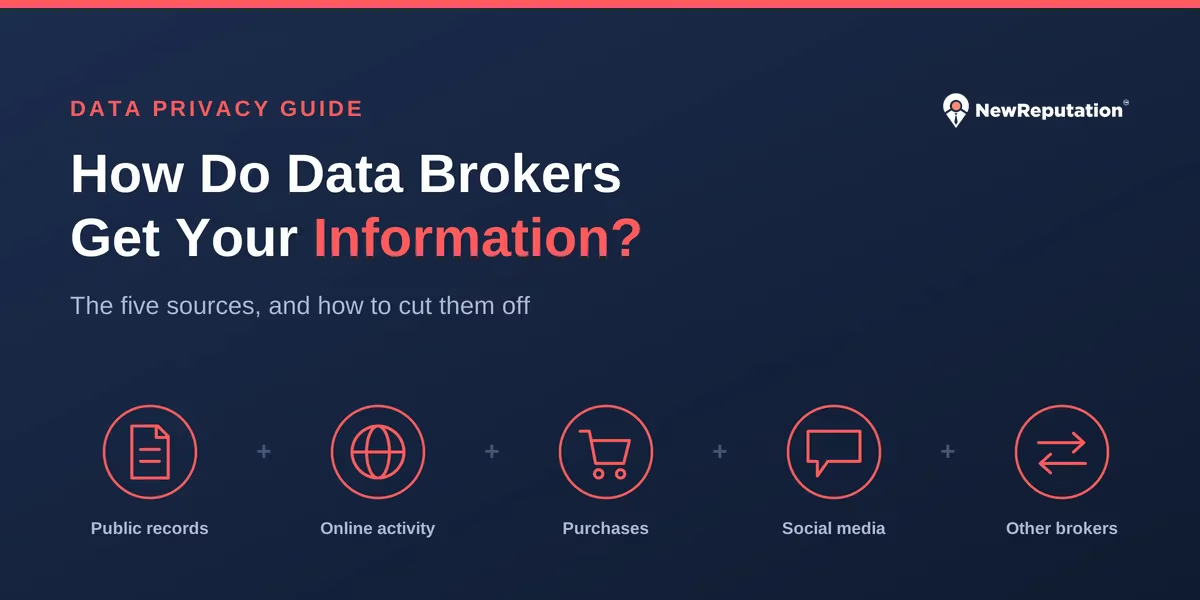
Data brokers get your personal information from five main sources, and almost none of it needs your permission. They pull public records like property deeds, voter registrations, and court filings; they buy your online activity from website trackers, apps, and advertisers; they collect your purchase history from loyalty programs and warranty cards; they scrape your public social media; and they buy and resell data from other brokers. Combined, this builds a detailed profile of you. It is largely legal in the US, where the industry is loosely regulated, so removing yourself takes active effort.
If you have never handed your information to a data broker, it can feel impossible that one has a file on you anyway. But data brokers do not need you to sign up. They assemble profiles from information you leave in dozens of ordinary places, most of which you never think of as data collection. Understanding exactly where your data comes from is the first step to cutting off the supply, so here is how data brokers get your information, source by source.
Table of Contents
Where Data Brokers Get Your Information
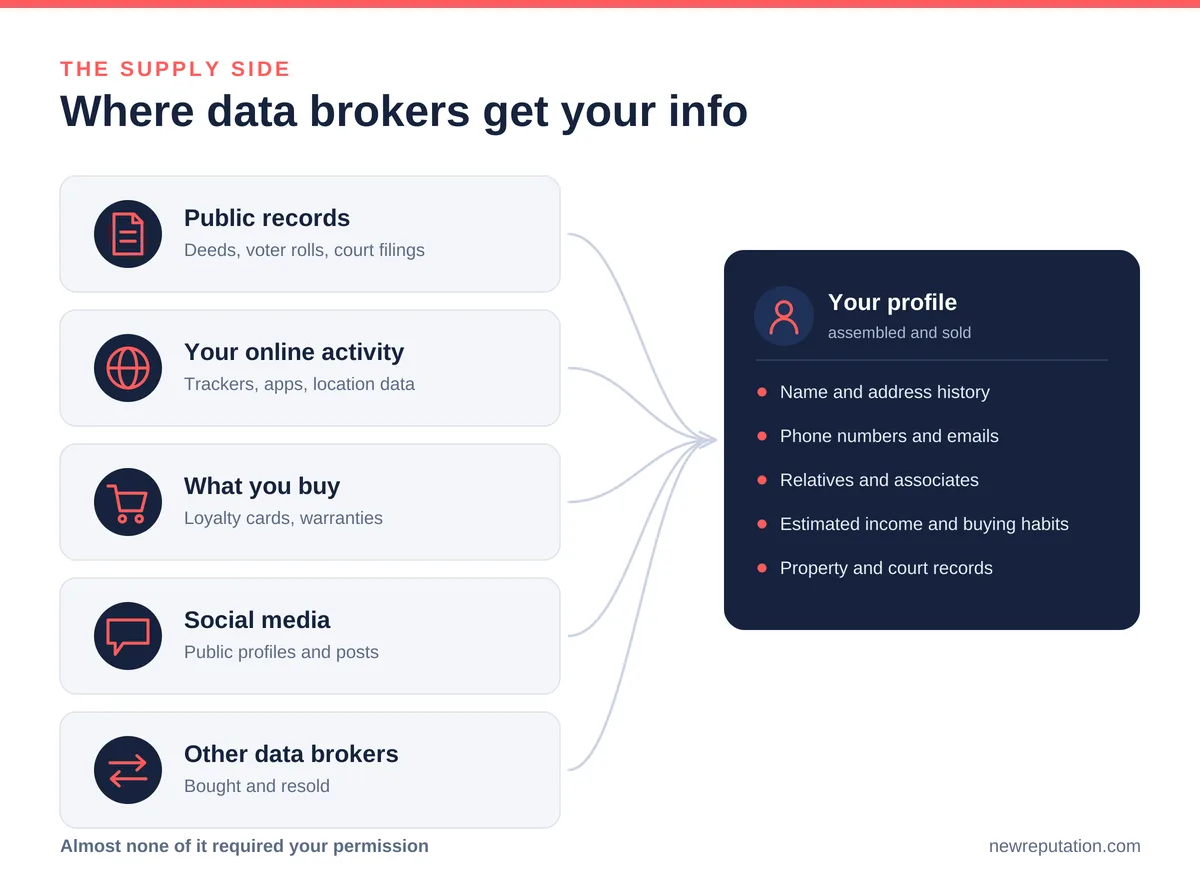
A data broker is a company that collects personal information about people and sells it, usually without any direct relationship with the people in its files. To build those files, brokers draw from five broad sources that feed into one another. Each source alone looks harmless. Combined, they produce a profile that can include your name, address history, phone numbers, relatives, income range, buying habits, and more. Our primer on what a data broker is covers the industry in full; this guide focuses on the supply side, which is where you can actually cut it off.
1. Public Records
Government records that are public by law
This is the backbone of most broker profiles, and the hardest to avoid.
A large share of what data brokers know about you comes from records that governments are required to make public. Brokers harvest these in bulk and cross-link them to your name. The common ones include property deeds and tax assessments, which tie you to an address; voter registration records; court filings, including lawsuits, bankruptcies, and liens; marriage and divorce records; business registrations; and professional licenses.
Because these records are public by law, they usually cannot be deleted at the source, which is why they are the sturdiest part of your profile. What you can control is whether new public records keep attaching your home address to your name, which the prevention section below covers.
2. Your Online Activity
Trackers, apps, and the advertising ecosystem
The biggest and fastest-growing source, and the one most invisible to you.
Nearly every website and app you use collects data about you, and much of it flows to brokers through the advertising ecosystem. Website cookies and trackers record what you browse, click, and search. Mobile apps collect device identifiers, and many request location data that reveals where you live, work, and travel. Ad-tech companies and some brokers buy this activity, link it to your identity, and fold it into your profile.
This is why your data ends up with brokers “even though you were careful.” You do not have to fill out a form; ordinary browsing and app use leak the data on their own. Reducing it means tightening app permissions, limiting tracking, and shrinking your overall footprint, which our digital footprint removal guide walks through.
3. What You Buy
Loyalty programs, warranties, and purchase history
The data you trade for discounts and convenience.
Every time you use a store loyalty card, register a product warranty, enter a sweepstakes, answer a survey, or subscribe to something, you generate commercial data that is often sold or shared. Retailers, catalog companies, and “list” sellers package purchase histories and mailing lists, and brokers buy them to enrich profiles with your buying habits, estimated income, household makeup, and interests.
This is the source people most often hand over without realizing it, because it is traded for a discount or a warranty. The terms that permit the sharing are usually buried in a privacy policy you clicked past.
4. Your Social Media and Public Profiles
Public profiles, posts, and photos
The information you publish yourself.
Anything you make public on social media and other sites can be collected. Brokers and the tools they use scrape public profiles, posts, photos, job histories, and the details in your bios to confirm and expand what they already have, such as your employer, location, relationships, and interests. Public profiles on professional networks are a particularly rich source because people fill them out thoroughly.
Setting profiles to private and trimming the personal details you publish limits this source directly, since it is one of the few that depends entirely on what you choose to share.
5. Other Data Brokers
Brokers buying and selling from each other
Why removing yourself from one site is not enough.
Data brokers do not just collect; they trade with each other. Large aggregators compile data and sell it to smaller people-search sites, which repackage it and sell it again. A single piece of information about you can pass through many hands, which is why your details reappear on sites you have never heard of, and why a listing you remove from one broker can repopulate from another.
This resale loop is the reason removal has to be thorough and repeated rather than one-and-done. Opting out of the big upstream aggregators slows how fast the smaller sites refill, which is covered in our data broker opt-out guides.
Is It Legal for Data Brokers to Collect Your Information?
In the United States, yes, mostly. There is no comprehensive federal law that bars data brokers from collecting and selling personal information, and in 2025 the Consumer Financial Protection Bureau withdrew a proposed rule that would have tightened oversight of the industry, leaving it loosely regulated at the federal level. Brokers operate legally as long as they follow the narrow rules that do apply, such as the Fair Credit Reporting Act when data is used for credit, employment, or housing decisions.
The meaningful protections are at the state level. California’s DELETE Act requires data brokers to register with the state and, through its DROP platform, lets residents send a deletion request to every registered broker at once, an obligation brokers must process as of August 1, 2026. Other states have their own rules. You can check what applies to you in our guides on data broker deletion rights by state and California’s DROP platform.
Because collection is largely legal and consent is buried in fine print, no one is going to stop this for you by default. Reducing your exposure is something you have to do actively, whether through state tools, individual opt-outs, or a removal service.
See Which Data Brokers Have Your Information
You cannot cut off the supply until you know who is holding your data. NewReputation’s free scan finds the data brokers and people-search sites that have built a profile on you right now.
- Find the brokers and sites exposing your information
- See what a stranger finds when they look you up
- Free scan, no obligation
How to Stop Data Brokers From Collecting Your Data
You cannot cut off every source, but you can shrink each one. Here is where effort actually pays off, roughly in order of impact.
- Opt out of the brokers and people-search sites directly. This removes existing profiles. Start with the large aggregators that feed the smaller sites, then work down the list.
- Use your state’s deletion tools. If you are in California, one DROP request reaches every registered broker. Other states offer their own deletion rights worth using.
- Keep your home address off new public records. Use a separate mailing address, such as a PO box or registered agent, for future filings so brokers stop harvesting your home address from fresh records.
- Tighten your online tracking. Limit app permissions, especially location, decline non-essential cookies, and reduce the data trail from browsing and apps.
- Lock down what you publish. Set social profiles to private and trim the personal details in public bios.
- Think before trading data for discounts. Skip loyalty programs, warranty registrations, and surveys you do not need, or use a secondary email for them.
- Recheck regularly. Because of the resale loop, removed data can return, so recheck the major sites every few months.
For the full routine from audit to removal to prevention, see our guides on how to remove personal information from the internet and how to protect your online privacy. Doing it thoroughly and keeping up with it is the part most people underestimate, which is where a removal service that works the sites continuously can save the time.
Frequently Asked Questions
How do data brokers get my information if I never gave it to them?
You do not need to give it to them directly. Data brokers collect from public records like property deeds and voter rolls, from your online activity through website trackers and apps, from commercial sources like loyalty programs and warranty registrations, from your public social media, and from other brokers who resell data. Each source captures a piece without your active involvement, and brokers combine them into a profile. That is why a broker can have a detailed file on someone who has never knowingly interacted with one.
Do data brokers use public records?
Yes, extensively. Public records are the foundation of most data broker profiles. Brokers harvest property and tax records, voter registrations, court filings, marriage and divorce records, business registrations, and professional licenses in bulk, then link them to your name. Because these records are public by law, they usually cannot be deleted at the source, which makes them the most durable part of your profile. The main defense is to keep your home address off new public records going forward by using a separate address for future filings.
Where do data brokers get their data online?
Mostly from the advertising and app ecosystem. Website cookies and trackers record your browsing and searches, mobile apps collect device identifiers and often location data, and ad-tech companies and brokers buy and link this activity to your identity. Your public social media profiles are also scraped. This online stream is the largest and fastest-growing source, and it is why your data reaches brokers even when you never fill out a form. Limiting app permissions, declining non-essential cookies, and reducing your footprint cuts it down.
Is it legal for data brokers to collect and sell my information?
In the United States, it is largely legal. There is no comprehensive federal law banning the collection and sale of personal data, and in 2025 the Consumer Financial Protection Bureau withdrew a proposed rule that would have increased oversight. Brokers must follow narrow rules like the Fair Credit Reporting Act when data is used for credit, employment, or housing. Stronger protections exist at the state level, such as California’s DELETE Act, which lets residents request deletion from all registered brokers at once.
Can I stop data brokers from collecting my information?
You cannot block every source, but you can shrink each one. Opt out of the brokers and people-search sites directly, use state deletion tools like California’s DROP where available, keep your home address off new public records by using a separate mailing address, tighten app permissions and tracking, and set social profiles to private. Because brokers resell data to each other, removal has to be repeated rather than one-time. A removal service can automate the opt-outs and re-removals if you do not want to manage it yourself.
Why does my information come back after I remove it from a data broker?
Because data brokers continuously rebuild their files from public records and from each other. Large aggregators sell to smaller people-search sites, so a listing you remove from one can repopulate from another within weeks or months. This resale loop is normal and does not mean your opt-out failed. The fix is to opt out of the upstream aggregators too, keep new public records from carrying your home address, and recheck the major sites every few months to catch anything that returns.
Cut Off the Supply, and Keep It Cut Off
Knowing where your data comes from is step one. NewReputation removes your information across hundreds of data brokers and people-search sites, then monitors and re-removes anything that comes back through the resale loop.
- Removal across hundreds of sites, handled for you
- Upstream aggregators included, not just the obvious sites
- Ongoing monitoring so it does not resurface
This article provides general information about data privacy and is not legal advice. Data broker regulations vary by state and change over time.